In just two years, this Falmouth robotics team made it to the global stage
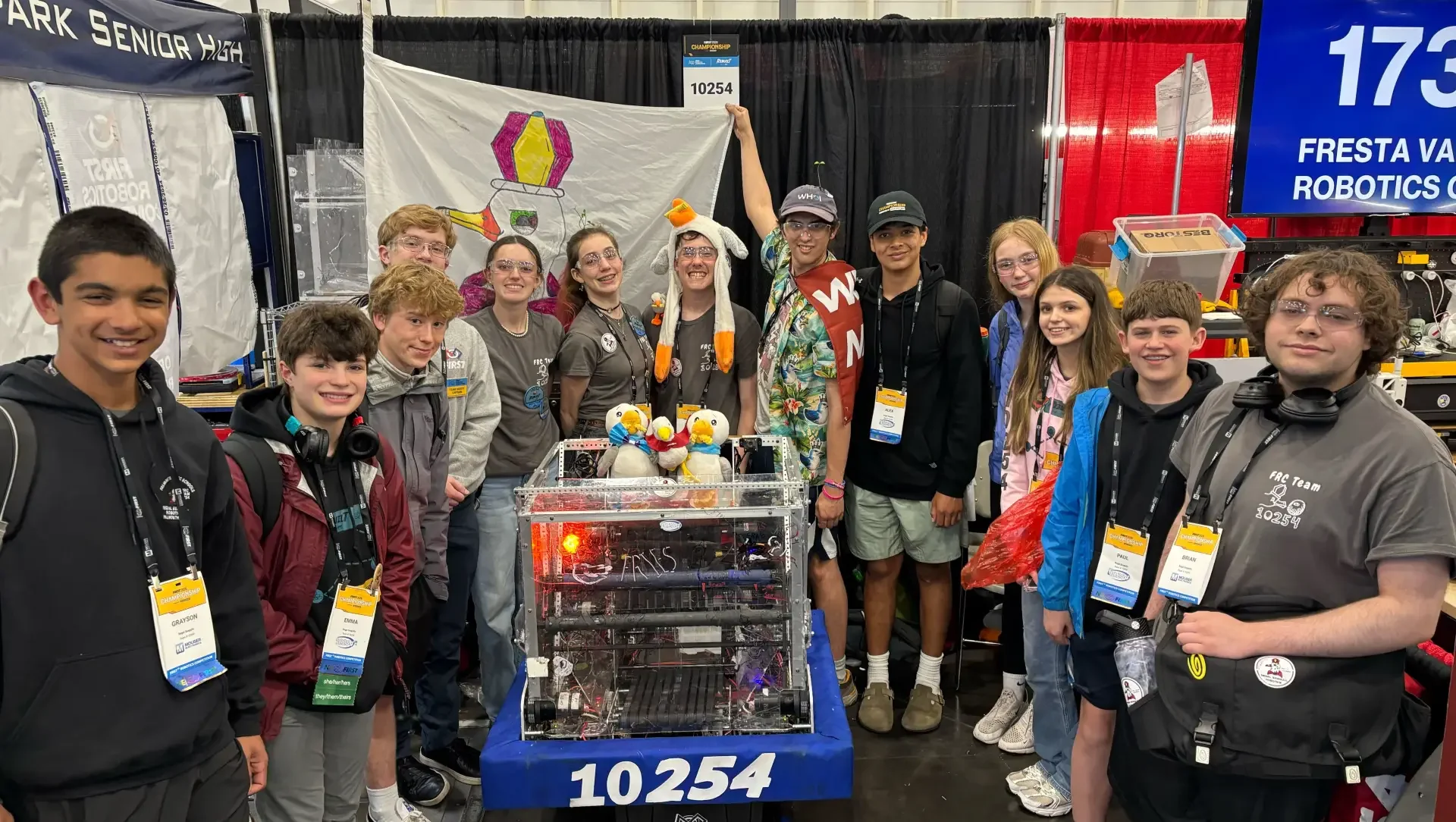
Photo by Allison Stickland

By Kana Ruhalter and
May 04, 2026
Two years ago, a brand new robotics team at Falmouth High School, the Regal Seagulls, had just five students, a handful of mentors and a rookie robot named Lulu. This year, the Regal Seagulls went to Houston for a world championship robotics competition.
Along the way, they’ve grown, refined their engineering and built a high-performance robot named ROAR-E. For this week’s Joy Beat, two of the Regal Seagulls — Falmouth High School senior Ethan Parmentier and junior Sam Irving — joined GBH’s All Things Considered guest host Saraya Wintersmith to share this Cape Cod success story. What follows is a lightly edited transcript of their conversation.
Saraya Wintersmith: It’s really cool to have you on from the World Championship! Ethan, let’s start with you. Take us back to year one. What did this team look like when it started, and how different does it feel now, heading into a world championship?
Ethan Parmentier: I feel like I’m a great person to ask, because I was here before year one. In fact, a couple of years before we were a FIRST [For Inspiration and Recognition of Science and Technology] team, we were a VEX Robotics team. It was a smaller-scale kind of event, more like LEGOs than anything like an actual engineering project, really. It was a couple of friends just hanging out.
Fast forward a year after that, and we have an actual robotics competition at our school called Clipper Clash, and I really got to see how engineering opportunities at our school could be if we really pushed for it. We’ve had a really great success story over the last couple of years.
The differences between this year and last year… We were really not expecting to have as many resources as we did, as many mentors and support as we did, so to really have access to all of that — thanks to sponsors like the Falmouth Education Foundation, Falmouth Public Schools, our wonderful mentors and the dedication of all of our team members — it’s been a dream for me. This is nothing less than exactly what we should have in every public school — every school system, really.
Wintersmith: That’s so exciting. Sam, I mentioned ROAR-E at the beginning. Can you tell us more about your robot and what sets it apart in this competition?
Sam Irving: Our robot design is based on two main parts — or, I guess, three main parts. You have our intake, our hopper and our shooter.
How the intake works is you have a roller that spins, and so it picks up our game pieces, which are a little bit bigger than a softball, to put it into perspective. And then, we pick up those off the ground.
Then, our hopper — which I would say is one of the biggest pieces of our robot — can hold about 65 to 70 balls. Compared to many other teams, that is almost double to triple how much they can hold in their robots.
We have a fun tradition that we did last year that we’ve continued this year, and we hope to continue in the future, of drawings on our robot. Our wonderful driver and some of our other students are very artistic, so they’ve designed many different seagull drawings or inside jokes that we put on our robot for not only our entertainment, but for other teams as well.
And then, the balls go through a shooter, and that’s what helps us score points in this game.
Wintersmith: That’s so cool. You’ve grown quickly as a team. What’s been the biggest challenge along the way?
Parmentier: I’d say that our team has had a lot of growing pains, really. Considering the scope of the project and how little funding and members we had last year compared to any other team, we weren’t expecting to get as far as we did with what we had. We did, thanks to the wonderful dedication of our students, faculty and mentors.
We made it to both state championships and the New England District Championships. That was so unexpected that our lead mentor actually booked a trip during district championships and was not there! We were completely blown away. A similar thing happened here, with us going to the world championships. We had a better idea of our expectations this year than before, but at the same time, we never could have imagined that we’d be here in Houston, Texas, today.
It’s starting to kind of show because our robot was designed to make it through district championships, not to make it through worlds, so there’s been a lot of maintenance. We’ve had to restructure things because we have a lot more students to delegate tasks a lot more smoothly. But all in all, it’s worked out, and we’re happy to be here.
Wintersmith: Sam, on that note, because you’re Zooming into us from Houston at the competition, and you’re surrounded by these other teams from around the world, how are you feeling? Are you intimidated, or is it energizing you?
Irving: It’s definitely a bit of both. It’s incredible seeing teams that are both at our same level, but also with teams that have been around for years. You have the teams that are fully known worldwide, but everyone here is just so nice, kind and welcoming.
As intimidating as it is, being in a building with 600 other FRC [FIRST Robotics Competition] robots — which is the competition we’re a part of, and then, you also have kids from FTC [FIRST Tech Competition] and FLL [FIRST LEGO League] — it’s amazing to see what this program offers for kids and the number of people this program has touched.
It’s also really great because we get to see what we could be in the future. We’re able to take ideas and inspiration from these better teams and be able to integrate them into our program, and what we can do to then grow as a team and as a community in engineering.
Wintersmith: If you had to sum it up, what’s been your biggest takeaway from this experience? Is there anything you’d say to other students [who are] thinking about getting started in robotics, but are hesitant?
Irving: Absolutely. I’ve always kind of been interested in engineering. I never fully knew that’s what I wanted to do, but as a kid, I loved LEGOs. I love putting things together. I loved math and science. So, when I heard that there was a robotics team, I was kind of questioning it at first, but it really has been the best decision I’ve made.
The last two years have been my absolute favorite. The experiences are amazing — the people I’ve met, not only in our team and in our community, but kids from all around New England and now, all around the world. It’s just an incredible experience being able to talk to other kids.
Something that I’d really like to point out is that you don’t have to be a science nerd or computer nerd to be on a robotics team. You need your photographers, your media people, your outreach people — there are so many different roles on these teams, and they’re all so equally important. Anyone can join, anyone can have fun, and it’s just such an amazing opportunity that if there’s anyone out there who is possibly thinking about joining the team at their school, or even starting their own team, I absolutely endorse it.
I’ve had the best time of my life, and there are so many teams and people who are willing to help you get started and make sure that you have the best time.